
In Hindi, there is a word that has no exact equivalent in English, ‘Jugaad’.
Roughly, it describes a mindset of applying hack solutions when solving problems using scarce resources, like a farmer building a makeshift irrigation pump from discarded bicycle parts.
Simply put, it is “the art of figuring it out with what you’ve got”, and it exists everywhere that scarcity meets ingenuity, including right in front of us in Machakos.
A small fire and a whole lot of rocks
This year, we have been constructing water pans in Machakos, enabling smallholder farmers to harvest rainwater for farming and household use, and to make this happen, over 30 young men from the local community have been helping.
While digging at one site, however, they hit a wall. Beneath the topsoil lay a shelf of rock so thick and unyielding that their pickaxes made limited progress even after days of hard work.
One afternoon, as the crew sought to make progress, an older man strolling by the site came across the work, and upon watching them struggle, suggested that they light a controlled fire on top of the area.
The heat, he explained, would cause the stone to expand, and once it did unevenly, it would crack, making it easier to break through. And it worked! What had taken weeks of exhausting labour became breakable in just a few days.
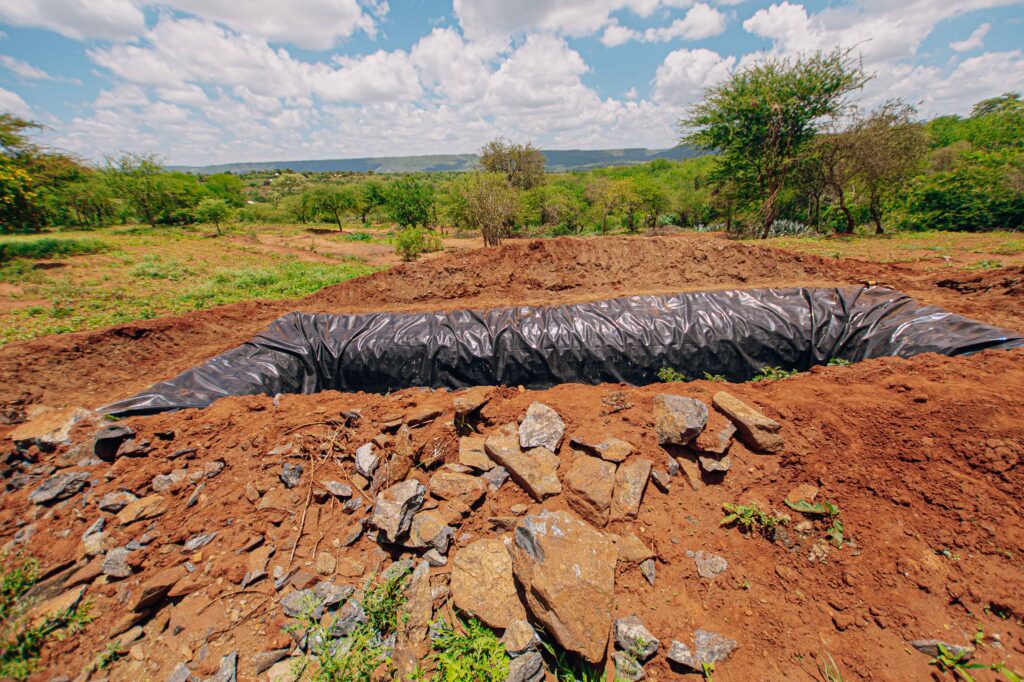 Some of the rocks (foreground) dug up while building the water pan. (Credit: Mishael Nduhiu)
The rocks, of course, are beside the point. We think about this moment as a principle. The instinct, when stuck, is to look outward, for example, by finding new technology, and sometimes that is the right call. But sometimes, more often than we might expect, the answer is already present.
While this is a striking story, the old man was not an exception, with the same principle operating every day in each farm in Machakos.
The women who have always known
Research from the baseline study we shared last month revealed that 93% of the farmers we surveyed expressed high confidence in adopting new farming practices that would give them an edge over the shifting climate. However, these farmers are already doing the work.
While 67% of them had received no formal training in good agricultural practices before joining our programme, a majority were already composting, rotating their crops, using manure and intercropping in ways that mirror what agronomists spend years designing.
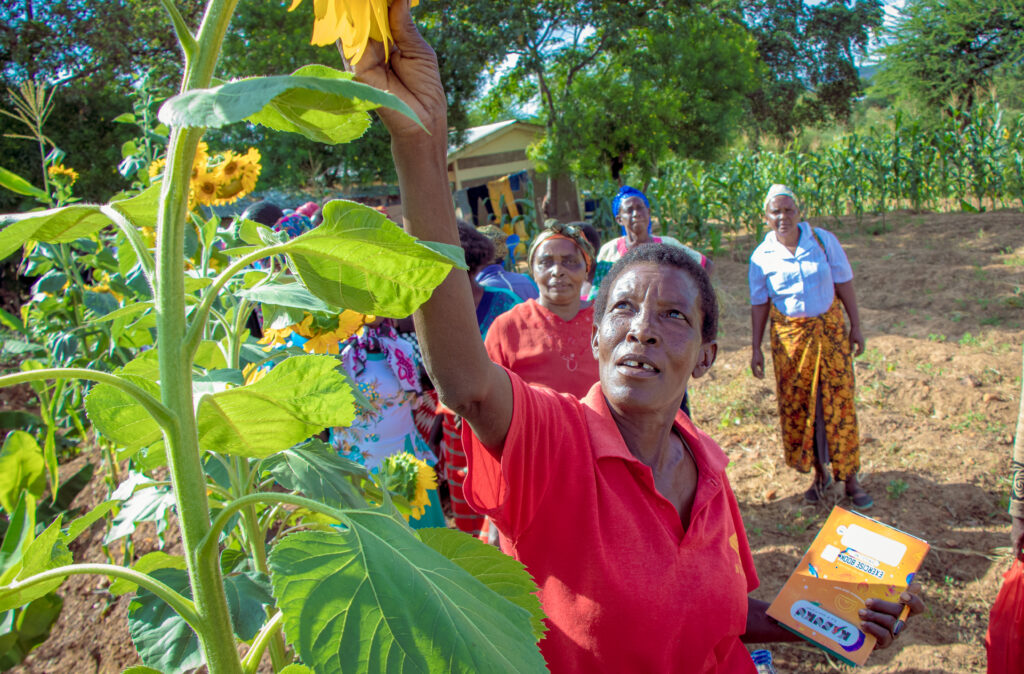 Women from Wamunyu, Machakos getting a hands-on demo of regenerative agricultural practices. (Credit: Eugene Kaggia)
This is not specific to Machakos. Plenty of research shows that smallholder women farmers across Sub-Saharan Africa (SSA) are the primary custodians of agricultural biodiversity, holding, applying and sharing indigenous knowledge about seed varieties, local plant species, soil management and polyculture that has been refined over generations.
For example, a study from Zimbabwe documented how women protect drought-tolerant crops like sorghum, rapoko and millet, which ensure household food availability amid climate shocks.
Many have been practising forms of regenerative agriculture long before the term existed. However, the climate these practices were designed around is no longer the same one they face today.
What we aim to do at IAG is not replace this knowledge, but build on it, helping time-tested knowledge hold up under these new, harsh conditions. For instance, we teach farmers how to turn the manure they already use into higher-quality compost, and prioritise helping farmers produce more consistent and higher-quality outputs from practices they already know and trust.
Climate scientists agree
We are not alone in arguing this. In its Sixth Assessment Report, the most comprehensive review of climate science ever conducted, the Intergovernmental Panel on Climate Change (IPCC) stated with high confidence that adaptation efforts have benefited from the inclusion of indigenous knowledge and local knowledge, and that integrating such forms of knowledge with existing practices increases the effectiveness of adaptation.
Another study done in Uganda of climate resilience practices across SSA shows that externally imposed resilience models consistently have less impact than locally anchored adaptation strategies, and that the most effective path forward blends indigenous knowledge systems with scientific methods. In other words, the answer is not to choose between local knowledge and external expertise, but rather to recognise that both are incomplete without the other.
The honest middle ground
However, we do not believe that local knowledge is always right. Communities can hold practices that are harmful, including beliefs that limit women’s participation in decision-making. What we argue is that local knowledge is a resource we ignore at our peril. And that the best solutions often emerge from partnership.
We also understand that while indigenous knowledge is highly valuable in the fight against climate change, the same climate variability is destabilising the farming systems around which that knowledge was built. Here, indigenous knowledge without additional resources becomes insufficient.
This is where partnership becomes the bridge. We bring resources, training in climate-smart practices and how to better adapt to a changing climate, water infrastructure and the ability to connect a small community in Machakos to a wider conversation about regenerative agriculture and climate resilience, while the community brings decades of direct observation of this specific land, knowledge of which practices hold up in different seasons, a social fabric of trust that makes peer-to-peer learning successful and practical problem-solving approaches.
Back to Jugaad
Communities are not passively waiting for climate solutions to arrive; they are already innovating, from building seed preservation networks to constructing water-harvesting systems with whatever they have at hand. They figure it out and adapt.
As any conversation with the women of Machakos will confirm, they are highly capable of identifying what they need. We therefore do not come with answers, but are ready to ask and listen, and with a genuine commitment to finding the answers together.