
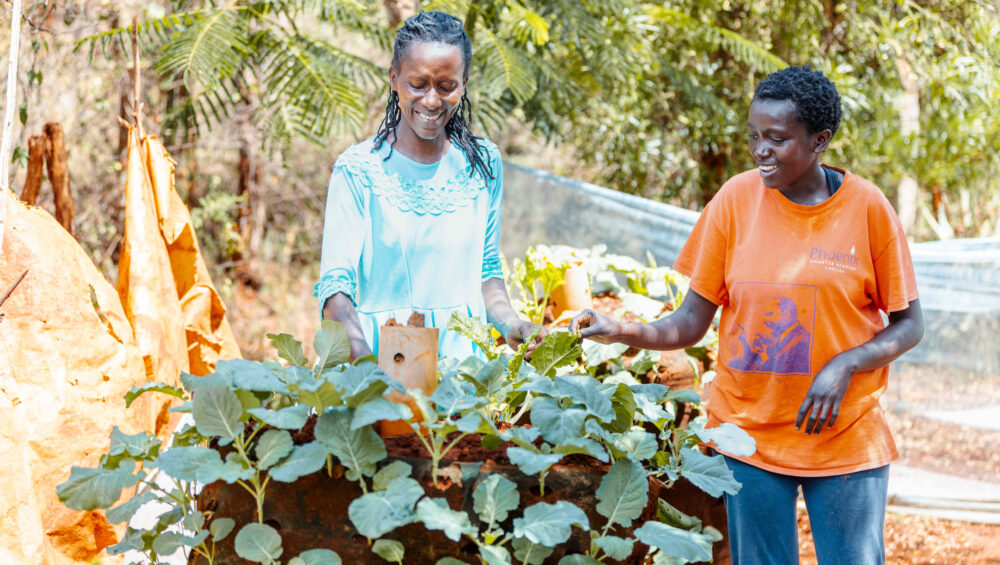
We are delighted to welcome two new funding partners: the Munich Re Foundation and the German Federal Ministry for Economic Cooperation and Development (BMZ), whose support strengthens our mission to dignify the livelihoods of smallholder farmers in Machakos, Kenya, and allows us to deepen the work we began in 2024 through the Resilience through Regeneration project.
To date, this project has reached over 170+ farmers trained on regenerative agriculture and water infrastructure development, and rehabilitated 2.5 acres of degraded land, establishing it as a demonstration farm to train more farmers.
The project, now entering its next phase, centres on equipping communities with tools to adapt to an increasingly unpredictable climate. It is practical work grounded in the realities of the farmers we serve, and built around the principle that lasting change must be shaped by the people it is meant to benefit.
The new phase will see us deepen our work in various ways. We will:
- Train over 300 farmers in regenerative practices, equipping them with knowledge that rebuilds soil health and improves harvests.
- Construct 6 household water pans, each one a reservoir that frees farmers from total dependence on unpredictable rains.
- Plant over 1,000 trees, restoring biodiversity.
- Connect over 50 households with vertical gardens, giving families a proven tool to grow nutritious crops while generating surpluses to sell and generate income.
We are grateful to the Munich Re Foundation and to BMZ for trusting us and for believing in the farmers we serve. Partnerships like these are what make it possible for us to stay rooted in community, year after year.
Before a single seed Is planted – our baseline research
Before beginning this new phase, our team spent time in Machakos with female smallholder farmers to listen to and understand where they are now, what is working for them, what their worries were, and what they needed, ensuring that the work we designed is effective.
We surveyed 27 farmers across the community, and the data we gathered tells a human story.
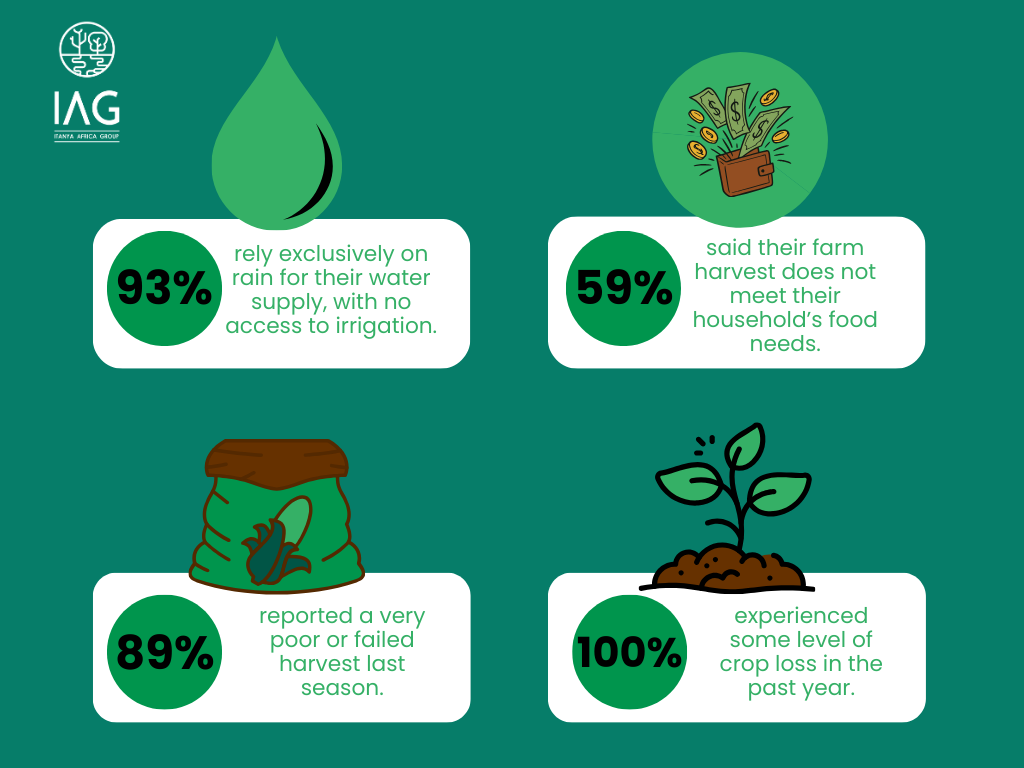
Every farmer we spoke to relies on rain-fed agriculture. In an average household of five, one or two children also depend on these harvests for school fees and daily meals. But as rains grow more unpredictable, a quiet anxiety shapes their daily lives. When we asked about their biggest challenge, one word kept coming up: water — the lack of it, the distance to it, and the cost of accessing it.
Their hopes meanwhile, were simple and powerful: school fees, savings, food, and knowledge. One woman spoke of her desire to earn enough to educate her children, and another of investing in livestock to build stability. These are the everyday ambitions of women who work the land, hoping it will be enough.
The data also revealed something critical. When asked about adopting new farming practices, 93% expressed high confidence. They are not waiting to be rescued; they are ready to learn and adapt, but need the right support.
This baseline research is our compass, guiding every intervention. For example, 59% had never heard of regenerative agriculture, highlighting both the gap and the opportunity to build knowledge from the ground up. It also showed the power of farmers already trained, who can influence and support others.
In the next phase, we will strengthen this multiplier effect, equipping farmers not only to learn, but also to teach. Because change that spreads from farmer to farmer is change that lasts.
Impact in Action: Pauline’s Story
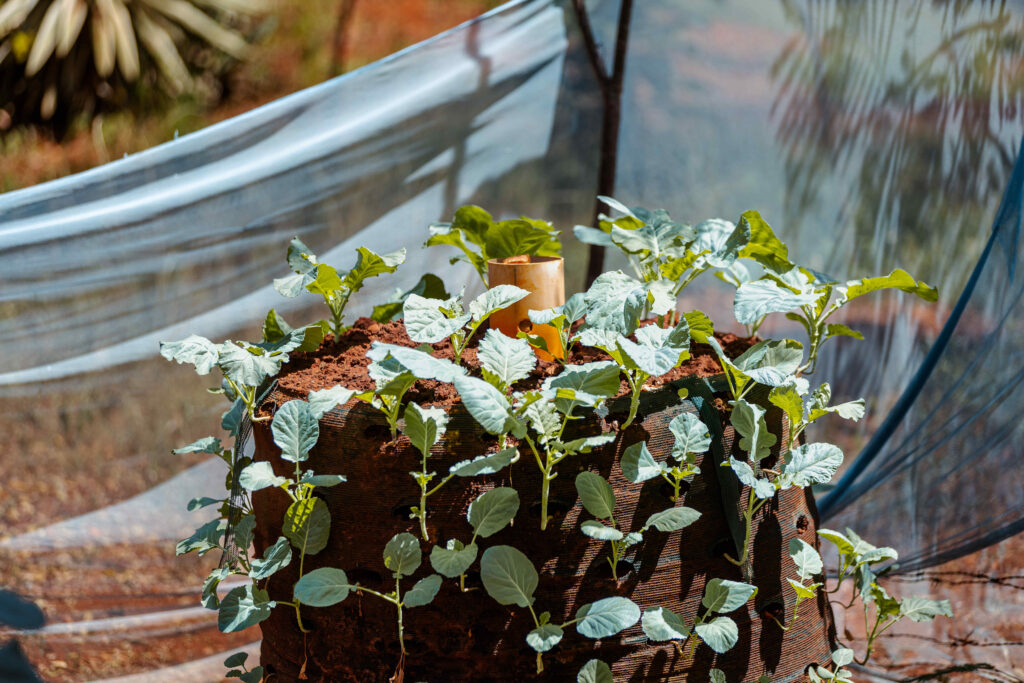
Listening is only half the work. The other half is acting on what we hear and demonstrating that change is possible. To illustrate this, we close with Pauline’s story, a smallholder farmer from Wamunyu, because behind every data point is a real person making real decisions.
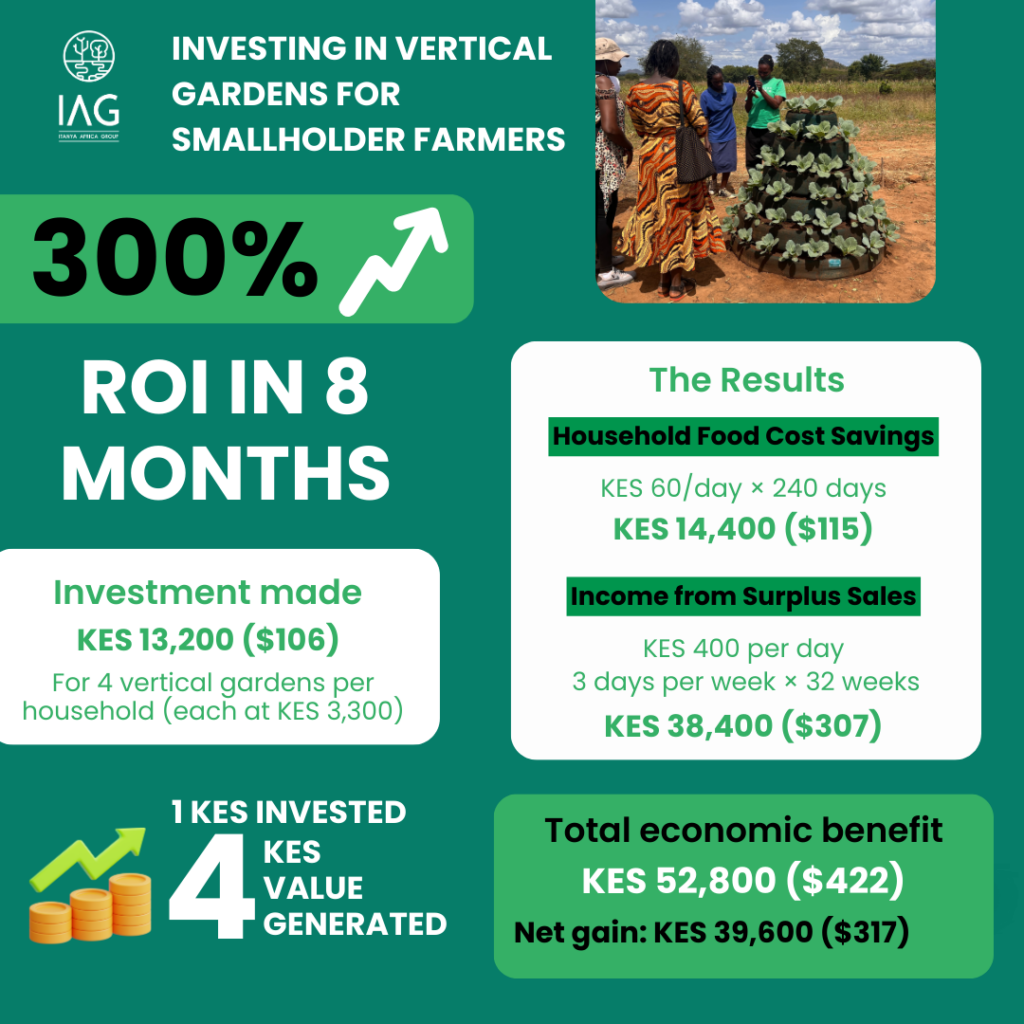
Before joining the programme, Pauline relied entirely on buying vegetables, spending about 60 KES daily. This strained her income and limited her ability to save or invest. Through the project, she received four vertical gardens worth KES 13,200 ($105). These space- and water-efficient gardens enabled her to grow kales and spinach year-round, improving both nutrition and income.
Within eight months, the gardens had transformed her household economy. She saved 14,400 KES by no longer purchasing vegetables, and earned an additional 38,400 KES from selling surplus produce that she managed to sell three days every week to local vegetable retailers.
In total, this translated to an economic benefit of 52,800 KES ($422), with a net gain of 39,600 KES ($317), representing a 300% return on investment, excluding longer-term gains as the gardens continue to produce.
Impact:
Pauline now has reliable household vegetable security, a steady income, and greater economic independence. More importantly, her experience demonstrates that low-cost vertical gardens can be a scalable and cost-effective solution to food insecurity and household poverty among smallholder farmers.
The gardens are just one part of the Resilience through Regeneration project, but Pauline’s story shows what happens when farmers receive practical tools and the knowledge to use them: they not only feed their families, but also support their communities.
Looking ahead
With the support of the Munich Re Foundation and BMZ, we now have the opportunity to take this model further: to add water pans that capture and store rain, to expand our demo farm into a living classroom, to train more women in regenerative practices that heal the soil even as they produce food, and to do it all in a way that starts not with a plan, but with the people.